Team,
When I started my tenure as a Flag Officer nearly twelve years ago (December 2000), it was a very different period for our Navy and our nation. USS COLE had been attacked two months prior (and would ultimately change the way our Navy trains and conducts ATFP), but we were still nine months away from one of the most significant events in our nation’s history – the 9/11 attacks.
The attacks on 9/11, and the ensuing wars in Afghanistan and Iraq, required our Navy to rapidly adapt and bring new capabilities to a new fight in a new environment. Consequently, over the last decade we’ve developed new Irregular Warfare capabilities, reestablished our Riverine forces, and supported the land campaign in every way possible (including deploying our Sailors into combat ashore as Individual Augmentees alongside their Marine and Army counterparts). And we’ve done it all while executing our “conventional” missions (SSBN patrols, BMD, Carrier Ops, etc.) and developing the next generation of the Navy’s warships and aircraft. While our deployments and missions over the last decade have been heavily influenced by the wars in Afghanistan and Iraq, the fundamental purpose of our Navy – to project power and influence from the sea – and our Title X responsibilities have not changed.
As we begin to wind down from the war in Afghanistan and continue the strategic rebalance to the Asia-Pacific region, we must be ready for a sustained, long-term global effort. This renewed focus on the Asia-Pacific does not absolve us of our responsibilities in other parts of the world and it certainly does not mean our enemies will stop trying to harm us simply because we have other work to do. Like it or not, the world is (and will continue to be) a volatile and violent place in which new threats to our national security emerge every day. And, like it or not, our Navy is the answer to these challenges. Whether it’s the violence in Syria that threatens the stability of the Eastern Med, Iran’s continued march toward developing nuclear weapons, or ensuring free and open access to the various choke points at sea that are absolutely critical for our nation’s commerce, our Navy is on station (24x7) and ready to protect our national interests.
And that’s why we must be ready. All of the initiatives on which we’ve worked so hard the past three years – raising the bar on our pre-deployment training for our CSGs, ARG-MEUs and independent deployers, revitalizing the Navy-Marine Corps relationship (and getting back to our core Naval roots!), reinvigorating and funding the programs to ensure our ships reach expected service life, increasing and improving waterfront training, and putting our Sailors back on ships – are absolutely critical for our Sailors and ships to meet the demands of our future. Because if history is any indication of the future, our Navy will be at the forefront of our nation's response to these challenges and it will be our Sailors and ships that will carry the might and mission of the United States forward. I believe we are indeed entering a uniquely Naval-oriented era.
While we certainly can’t predict where and when the next event will occur, we must be absolutely ready to respond because I can assure you we will be called. If you wear our uniform today, you must be ready mentally and physically, for this is our time…this is your time.
All the best, JCHjr
Showing posts with label Commander. Show all posts
Showing posts with label Commander. Show all posts
16 August 2012


03 August 2012
Thoughts on Blogging
Team,
It’s been a little over three years since I took command of Fleet Forces and started this blog. Throughout my tour, this blog has been an important way for me to share my thoughts and solicit feedback on various topics that I believed were important to the Fleet. I’ve learned about many issues of which I’m not sure I would have otherwise discovered, talked with and helped Sailors who needed additional information on certain topics or had experiences that required improvement to our policies and processes, and received a great deal of valuable feedback from readers who cared enough about the Fleet and our Sailors to sit down and type a meaningful response.
Throughout my time blogging, I’ve been very impressed by the hard work many of you in the “blogosphere” put into maintaining your blogs and producing quality content. And while we don’t always agree on our Navy’s “hot topics,” I want you to know that I’ve greatly enjoyed being an active member of this community and contributing to the discussion – whether on your blog or mine. With that said, I want to be clear that this is certainly not goodbye (not yet at least). I have a few more posts that I look forward to sharing over the next few weeks before I sign off for the last time. In the meantime, I want to share a few brief thoughts on blogging with those of you who are considering a blog as an additional way of communicating with your command/staff.
Understand the commitment
First and foremost, make sure you understand the level of commitment involved with posting frequently and following up on comments. We’ve all seen blogs that start with great promise and then quickly fade away because the owner did not fully understand or appreciate the level of commitment required. This blog has required a considerable amount of my time, but it has also been an extremely valuable tool for me (in my current position) and I’ve actually enjoyed every moment I’ve devoted to it.
Stay engaged
I believe this blog has been effective because of the meaningful two-way communication I established with my readers. There were quite a few times I was given the good, the bad and the ugly on this blog, but I wouldn’t have it any other way. Because of the open and honest dialogue, I’ve been able to help many of our Sailors understand and work through some of the more unique problems in our Navy (such as IA deployments). Quite frankly, I had hoped for more two-way dialogue directly from the Fleet, but I understand the many reasons for the reluctance of some to engage. It turns out my readership was an expanding group over time and I looked forward to reaching out to them even if I didn’t usually hear back from them.
There’s nothing wrong with starting a blog simply to transmit information to your people, but I personally believe a blog is most effective when you have an open and active dialog with your readers. But regardless of how you choose to run your blog, I strongly recommend that you never ask for feedback from your readers if you’re not willing to follow-up on the information you receive. There’s no quicker way to lose credibility with your Sailors.
Keep it in perspective
Finally, always remember that the blog is not about you, it’s about your command, your mission and your people. Whether you’re sharing your thoughts on a particular topic to ensure your intent is understood, highlighting the unique capabilities of a unit you recently visited, or soliciting feedback on a particular idea, the focus should always be on the command and the people and how you can help improve mission performance. Because at the end of the day, it’s our Sailors and our Civilian teammates who make our Navy great, and who accomplish the mission, day in and day out.
All the best, JCHjr
It’s been a little over three years since I took command of Fleet Forces and started this blog. Throughout my tour, this blog has been an important way for me to share my thoughts and solicit feedback on various topics that I believed were important to the Fleet. I’ve learned about many issues of which I’m not sure I would have otherwise discovered, talked with and helped Sailors who needed additional information on certain topics or had experiences that required improvement to our policies and processes, and received a great deal of valuable feedback from readers who cared enough about the Fleet and our Sailors to sit down and type a meaningful response.
Throughout my time blogging, I’ve been very impressed by the hard work many of you in the “blogosphere” put into maintaining your blogs and producing quality content. And while we don’t always agree on our Navy’s “hot topics,” I want you to know that I’ve greatly enjoyed being an active member of this community and contributing to the discussion – whether on your blog or mine. With that said, I want to be clear that this is certainly not goodbye (not yet at least). I have a few more posts that I look forward to sharing over the next few weeks before I sign off for the last time. In the meantime, I want to share a few brief thoughts on blogging with those of you who are considering a blog as an additional way of communicating with your command/staff.
Understand the commitment
First and foremost, make sure you understand the level of commitment involved with posting frequently and following up on comments. We’ve all seen blogs that start with great promise and then quickly fade away because the owner did not fully understand or appreciate the level of commitment required. This blog has required a considerable amount of my time, but it has also been an extremely valuable tool for me (in my current position) and I’ve actually enjoyed every moment I’ve devoted to it.
Stay engaged
I believe this blog has been effective because of the meaningful two-way communication I established with my readers. There were quite a few times I was given the good, the bad and the ugly on this blog, but I wouldn’t have it any other way. Because of the open and honest dialogue, I’ve been able to help many of our Sailors understand and work through some of the more unique problems in our Navy (such as IA deployments). Quite frankly, I had hoped for more two-way dialogue directly from the Fleet, but I understand the many reasons for the reluctance of some to engage. It turns out my readership was an expanding group over time and I looked forward to reaching out to them even if I didn’t usually hear back from them.
There’s nothing wrong with starting a blog simply to transmit information to your people, but I personally believe a blog is most effective when you have an open and active dialog with your readers. But regardless of how you choose to run your blog, I strongly recommend that you never ask for feedback from your readers if you’re not willing to follow-up on the information you receive. There’s no quicker way to lose credibility with your Sailors.
Keep it in perspective
Finally, always remember that the blog is not about you, it’s about your command, your mission and your people. Whether you’re sharing your thoughts on a particular topic to ensure your intent is understood, highlighting the unique capabilities of a unit you recently visited, or soliciting feedback on a particular idea, the focus should always be on the command and the people and how you can help improve mission performance. Because at the end of the day, it’s our Sailors and our Civilian teammates who make our Navy great, and who accomplish the mission, day in and day out.
All the best, JCHjr
20 June 2012
“Character” by VADM John M. Richardson
Team, VADM Richardson just posted the following post on his COMSUBFOR blog. Although he wrote it with the Submarine Force in mind, I believe his message is dead-on and applies to all of us as well. Give it a read and let us know what you think. All the best, JCHjr
Originally posted by VADM John M. Richardson, Commander, Submarine Force: http://comsubfor-usn.blogspot.com/2012/06/character.html
Character
It’s been a long time since I last added to this blog. So long, in fact, that I considered just shutting it down! It seems that there is no greater sin in the blogosphere than to be dormant. It’s not as if we have been quiet. Since making the last post, I have given 20 or so speeches, written an article for the U.S. Naval Institute’s PROCEEDINGS magazine (the magazine that contains our Navy’s intellectual dialogue, and one I HIGHLY recommend), and have made several trips around the Force. So now that I’m back, I thought that I’d share some thoughts I’ve had since I last posted.
I’ve been talking to the Submarine Force about two things:
Our character – our moral and ethical quality - is hard-wired to the success of our mission as a Navy, and particularly as naval leaders. From my standpoint, we need to pay particular attention to this in the submarine Force. Let me explain…
Our submarine force offers an important, unique contribution to our navy and our nation: we have a significant hard and soft kill payload that can go to sea and stay undetected for months at a time. We can and do go anywhere in the world and operate independently without logistic support or communications – truly self-sustaining. We are independent and invisible, providing our nation’s decision-makers with a wide range of options; most notably, a non-provacative platform that can quietly inform diplomacy one day, and then enforce it the next. Invisibility and independence is our advantage and it’s critical to our mission.
But our advantage comes with responsibility. In order to maintain the trust and confidence of our leaders and Sailors, we must constantly be assessing, correcting, and improving ourselves. We must get underway, and left largely to our own devices, return stronger than when we left.
Invisibility and character have a long relationship, and it hasn’t always been a healthy one. Being out of sight can uniquely challenge one’s character. This is not a new idea. In the Second Book of the Republic, written around 400 BC, Plato describes the challenge of the Ring of Gyges – a ring that will make its wearer invisible. From The Republic:
Suppose now that there were two such magic rings, and the just put on one of them and the unjust the other; no man can be imagined to be of such an iron nature that he would stand fast in justice. No man would keep his hands off what was not his own when he could safely take what he liked out of the market, or go into houses and lie with any one at his pleasure, or kill or release from prison whom he would, and in all respects be like a god among men.
Then the actions of the just would be as the actions of the unjust; they would both come at last to the same point. — Plato's Republic, 360b-d (Jowett trans.)
Plato surmised that we are moral because we must be – and that left unchecked by society’s eye, we’d devolve to a state of low morality, of low character. Beyond Plato and several examples in mythology (think Gollum in Tolkein’s Lord of the Rings), there is plenty of evidence to support this proposition. One only need consider the more recent examples of the Stanford Prison Experiment in 1971 or the abuses of Abu Ghraib prison in 2004-2006, both of which had elements of “invisibility,” to find examples of the degeneration of character that can occur when you think no one is looking. In short, Plato may have been on to something.
The Navy has been interested in the study of character, and its relation to being out of sight, for a long time – in fact the Stanford Prison Experiment mentioned above was funded by the Office of Naval Research. It makes sense – ships are on their own, out of sight – exhibiting some of the same elements that can lead to the sort of trouble that Plato talked about almost 2500 years ago. Even within the ships themselves there are opportunities for this “out of sight” behavior. Submarines even more so. If we think about instances of hazing, they often occur in areas of the ship that have been allowed to become remote – out of the normal ship’s circulation and not visited often enough by supervision. They become “sanctuaries” for outrageous behavior. One important ingredient for eliminating hazing and other outrageous and undesirable behavior is to eliminate these out of the way, “invisible” sanctuaries.
Polls routinely show that the military usually ranks at or near the top of any list of institutions when it comes to the confidence of our citizens. That’s proper and just – they desperately believe that those defending this country, those willing to go into harm’s way for us and for other nations, are our most honorable. When we military leaders fall short in character, it shakes the foundation of the standard against which all others are measured - it’s front page news, and that should be no surprise. It’s a violation of the trust placed in us to take care of the sons and daughters, brothers and sisters, fathers and mothers that America sends to our care.
Any claim to leadership we have is founded on the trust and confidence that our Sailors, and the American People, have in us. It’s only possible to have that foundation if our leadership has strong character – strong moral courage. We KNOW what’s right, and we have the strength to DO what’s right. And furthermore, we have the responsibility – it’s our charge of command – to develop strong character in our subordinates, to build depth in our Navy now and into the future.
We’re not perfect. In the Submarine Force we’ve had some high-visibility lapses in character. You’ve read about them: the cheating incident on USS MEMPHIS, the fraternization between the Chief of the Boat and a female midshipman on USS NEBRASKA, an incident of hazing on USS FLORIDA, and the financial misconduct of some Supply Officers in Kings Bay. In each case, once discovered, these incidents were thoroughly investigated, and appropriate people were held accountable. This is our approach and we’ll continue to address these cases swiftly and decisively.
The discussion on these cases has been vigorous in the media and the blogosphere. I frequently take questions about these incidents when I travel – people want to know how this can possibly happen. To so many, it just doesn’t check…it’s so out of whack with their expectations, and feels so personal and close to home. A violation by one seems to be a violation against all. Again, we can’t be surprised by these feelings or the questions that come with them. Indeed we owe an explanation and we must participate in these discussions. Most of the substance of the media reports comes from the report of our own investigations that we release in response to Freedom of Information Act requests. And if we learn legitimate new information from these discussions in the media, we explore each new revelation until we have as complete a picture as possible.
Together with the rest of the Navy, Submarine Force leadership will continue to stress the importance of character in our force, and in particular our leaders. There is currently a vigorous and growing discussion of this throughout the force – that’s exactly how it should be. We need to take every opportunity to make character – our moral and ethical quality – not something exclusively academic but something we talk about directly every day. It should be part of our conversations in wardrooms and chief’s quarters. It should be discussed up front at our operational briefs – the importance of keeping our integrity intact. In this way, we make every evolution we do a leadership laboratory, a source of strength.
The Submarine Force is one of our nation’s true stealth forces. We get much of our strength from being invisible for long periods of time. To do this successfully, we must recognize the challenge that this poses and take every opportunity to make each other morally and ethically stronger – to strengthen the bond of trust and confidence we have within our Force and with our nation. Our best people – our Sailors – deserve nothing less.
Semper Procinctum
VADM John M. Richardson
Commander, Submarine Force
Originally posted by VADM John M. Richardson, Commander, Submarine Force: http://comsubfor-usn.blogspot.com/2012/06/character.html
Character
It’s been a long time since I last added to this blog. So long, in fact, that I considered just shutting it down! It seems that there is no greater sin in the blogosphere than to be dormant. It’s not as if we have been quiet. Since making the last post, I have given 20 or so speeches, written an article for the U.S. Naval Institute’s PROCEEDINGS magazine (the magazine that contains our Navy’s intellectual dialogue, and one I HIGHLY recommend), and have made several trips around the Force. So now that I’m back, I thought that I’d share some thoughts I’ve had since I last posted.
I’ve been talking to the Submarine Force about two things:
- Building depth – training and mentoring our future submarine force
- The importance of Character in what we do
Our character – our moral and ethical quality - is hard-wired to the success of our mission as a Navy, and particularly as naval leaders. From my standpoint, we need to pay particular attention to this in the submarine Force. Let me explain…
Our submarine force offers an important, unique contribution to our navy and our nation: we have a significant hard and soft kill payload that can go to sea and stay undetected for months at a time. We can and do go anywhere in the world and operate independently without logistic support or communications – truly self-sustaining. We are independent and invisible, providing our nation’s decision-makers with a wide range of options; most notably, a non-provacative platform that can quietly inform diplomacy one day, and then enforce it the next. Invisibility and independence is our advantage and it’s critical to our mission.
But our advantage comes with responsibility. In order to maintain the trust and confidence of our leaders and Sailors, we must constantly be assessing, correcting, and improving ourselves. We must get underway, and left largely to our own devices, return stronger than when we left.
Invisibility and character have a long relationship, and it hasn’t always been a healthy one. Being out of sight can uniquely challenge one’s character. This is not a new idea. In the Second Book of the Republic, written around 400 BC, Plato describes the challenge of the Ring of Gyges – a ring that will make its wearer invisible. From The Republic:
Suppose now that there were two such magic rings, and the just put on one of them and the unjust the other; no man can be imagined to be of such an iron nature that he would stand fast in justice. No man would keep his hands off what was not his own when he could safely take what he liked out of the market, or go into houses and lie with any one at his pleasure, or kill or release from prison whom he would, and in all respects be like a god among men.
Then the actions of the just would be as the actions of the unjust; they would both come at last to the same point. — Plato's Republic, 360b-d (Jowett trans.)
Plato surmised that we are moral because we must be – and that left unchecked by society’s eye, we’d devolve to a state of low morality, of low character. Beyond Plato and several examples in mythology (think Gollum in Tolkein’s Lord of the Rings), there is plenty of evidence to support this proposition. One only need consider the more recent examples of the Stanford Prison Experiment in 1971 or the abuses of Abu Ghraib prison in 2004-2006, both of which had elements of “invisibility,” to find examples of the degeneration of character that can occur when you think no one is looking. In short, Plato may have been on to something.
The Navy has been interested in the study of character, and its relation to being out of sight, for a long time – in fact the Stanford Prison Experiment mentioned above was funded by the Office of Naval Research. It makes sense – ships are on their own, out of sight – exhibiting some of the same elements that can lead to the sort of trouble that Plato talked about almost 2500 years ago. Even within the ships themselves there are opportunities for this “out of sight” behavior. Submarines even more so. If we think about instances of hazing, they often occur in areas of the ship that have been allowed to become remote – out of the normal ship’s circulation and not visited often enough by supervision. They become “sanctuaries” for outrageous behavior. One important ingredient for eliminating hazing and other outrageous and undesirable behavior is to eliminate these out of the way, “invisible” sanctuaries.
Polls routinely show that the military usually ranks at or near the top of any list of institutions when it comes to the confidence of our citizens. That’s proper and just – they desperately believe that those defending this country, those willing to go into harm’s way for us and for other nations, are our most honorable. When we military leaders fall short in character, it shakes the foundation of the standard against which all others are measured - it’s front page news, and that should be no surprise. It’s a violation of the trust placed in us to take care of the sons and daughters, brothers and sisters, fathers and mothers that America sends to our care.
Any claim to leadership we have is founded on the trust and confidence that our Sailors, and the American People, have in us. It’s only possible to have that foundation if our leadership has strong character – strong moral courage. We KNOW what’s right, and we have the strength to DO what’s right. And furthermore, we have the responsibility – it’s our charge of command – to develop strong character in our subordinates, to build depth in our Navy now and into the future.
We’re not perfect. In the Submarine Force we’ve had some high-visibility lapses in character. You’ve read about them: the cheating incident on USS MEMPHIS, the fraternization between the Chief of the Boat and a female midshipman on USS NEBRASKA, an incident of hazing on USS FLORIDA, and the financial misconduct of some Supply Officers in Kings Bay. In each case, once discovered, these incidents were thoroughly investigated, and appropriate people were held accountable. This is our approach and we’ll continue to address these cases swiftly and decisively.
The discussion on these cases has been vigorous in the media and the blogosphere. I frequently take questions about these incidents when I travel – people want to know how this can possibly happen. To so many, it just doesn’t check…it’s so out of whack with their expectations, and feels so personal and close to home. A violation by one seems to be a violation against all. Again, we can’t be surprised by these feelings or the questions that come with them. Indeed we owe an explanation and we must participate in these discussions. Most of the substance of the media reports comes from the report of our own investigations that we release in response to Freedom of Information Act requests. And if we learn legitimate new information from these discussions in the media, we explore each new revelation until we have as complete a picture as possible.
Together with the rest of the Navy, Submarine Force leadership will continue to stress the importance of character in our force, and in particular our leaders. There is currently a vigorous and growing discussion of this throughout the force – that’s exactly how it should be. We need to take every opportunity to make character – our moral and ethical quality – not something exclusively academic but something we talk about directly every day. It should be part of our conversations in wardrooms and chief’s quarters. It should be discussed up front at our operational briefs – the importance of keeping our integrity intact. In this way, we make every evolution we do a leadership laboratory, a source of strength.
The Submarine Force is one of our nation’s true stealth forces. We get much of our strength from being invisible for long periods of time. To do this successfully, we must recognize the challenge that this poses and take every opportunity to make each other morally and ethically stronger – to strengthen the bond of trust and confidence we have within our Force and with our nation. Our best people – our Sailors – deserve nothing less.
Semper Procinctum
VADM John M. Richardson
Commander, Submarine Force
17 May 2012
Our Reality

When I took command of Fleet Forces in July 2009, one of my first actions was to conduct an All-Hands call with my staff to inform them that we were entering a period of great challenge and sustained uncertainty. I told them I believed we were headed for permanent whitewater; that is, an environment in which our overall defense budget would very likely decrease, while our costs to own and operate the Fleet would likely continue to increase.

When you consider the environment we’re in today – our decreasing defense budget, looming sequestration cuts and increasing demand for our forces around the world – I believe we have indeed entered that permanent whitewater. And we’re in it at a time when we have an unprecedented percentage of the Fleet routinely forward deployed in a variety of “hot spots” around the world. While we have no idea yet when this whitewater will end (I believe we’re just getting started), we can be sure the demand for our forward-deployed Navy will not slacken one bit.
Now, I’ve served through several of these fiscal “downturns” over the course of my 39 year career. I was commissioned in 1973 during a particularly turbulent time for our nation. The public discontent with the war in Vietnam was very high (and taking its toll on our Navy), our nation was sharply divided on just about every national issue, we were on the cusp of a recession that would affect our nation (and our Navy) for the rest of the decade and the defense budget had dropped by about 25% over the previous five years. In many ways, it was a perfect storm of fiscal and social chaos. We faced similar challenges in the immediate post-Cold War period of the 1990s when our defense budgets steadily declined for nearly a decade (the “peace” dividend) and our Navy took a “procurement holiday,” the impact of which we are still feeling today. Each of these down cycles and turbulent periods posed their own unique set of challenges to our Navy, but they provide us with lessons that we can apply to our own situation today. I want to share with you some of the important lessons I learned during those times that I believe apply to everyone in the Fleet today, regardless of where you are in the chain-of-command or your community warfare specialty.
First, this is our reality and we must accept it. This whitewater and all the churn that comes with it is not going away anytime soon. The world is not going to settle down so we can take a “training time-out” and figure out how we’re going to deal with our new fiscal and operational environment. And we don’t have the option (nor do we want it!) of simply packing up and walking away when the times are tough. Now is the time to be thinking about how we’re going to adapt to an increasingly austere future in an increasingly volatile world. If we continue to operate under the “business as usual” mindset, we will fail. I can assure you that whatever our future looks like, it will not simply be business as usual.
Second, we must make the tough decisions that the times demand of us and own the consequences of those decisions. Fewer resources brings competing priorities. I wrote here over two years ago that in an environment with declining resources, there are things that we inevitably will not be able to do (ref: do less, but not less well). While our overall operational demand shows no sign of slowing down, fiscal discipline demands that we prioritize requirements and make the reuired decisions about how we will meet our missions. This area is not one in which we can simply stick our heads in the sand and hope for the best. Hope is never an acceptable strategy in our line of work. Hoping for a result means you’ve lost control of the situation or your ability to influence the outcome. We live with the consequences of our decisions, not our hopes.
Third, take ownership of your responsibilities. If you see a problem, be part of the solution. I talked earlier this year about BMC Pici and how he and his team took ownership of Corrosion Control on USS WINSTON S. CHURCHILL. BMC Pici had engaged the entire ship and created an environment in which every member of the crew was responsible for some aspect of corrosion control and prevention, just like every member of the crew is expected to have fundamental DC skills. And when given the opportunity, he took a chance and told me he needed paint floats because there weren’t any available (a problem RADM Dave Thomas and I promptly fixed). BMC Pici took ownership of his responsibilities and did what he felt he needed to do in order to ensure his team had the tools they needed to do their jobs – just like I want every Sailor in the Fleet to take ownership of their program, division, department, and command.
Finally, don’t lose sight of why we’re here. My job and commitment to our Sailors is to give them the tools, training and time they need to deploy confident in their ability to carry out their assigned missions. If you work at Fleet Forces, then your job should contribute in some way to this mission (i.e. providing Forces ready for tasking). We’ve reached a point where we all need to take a hard look at the many tasks we do each day and ask ourselves how it contributes to our mission. And we need to make the decisions (see previous paragraph) to stop spending resources on endless churn that has no clear benefit to our Sailors or our mission. We’re here to ensure our Sailors have what they need to get the job done. Period.
Many of the challenges we face every day are not exclusive to rank. Whether you’re a Flag Officer commanding a strike group or a Fire Controlman manning a weapons console in a DDG, your feedback on how we address our challenges is important. That’s why I’ve maintained this blog and fostered an open discussion up and down the chain-of-command for the three years I’ve been in command of Fleet Forces. At the end of the day, the onus is on us to take ownership of the Fleet and ensure we remain the Ready, Responsive, and Relevant force our nation needs. All the best, JCHjr

12 March 2012
University of Notre Dame NROTC Remarks
Team,
I recently had the great privilege of visiting with Naval ROTC students from around the country as keynote speaker for the 2012 Naval Leadership Weekend hosted by the University of Notre Dame NROTC Unit (my remarks here). Notre Dame shares a great history with our Navy, having been selected as a training location for our officer candidates early in World War II when the university faced severe financial difficulties after losing much of its enrollment due to the draft.
The Naval leadership event was held in the Press Box at the historic Notre Dame Stadium. For the 17th consecutive year, NROTC students from across our nation came together to discuss issues critical to their roles as Navy and Marine Corps leaders. I very much enjoyed the opportunity to speak with these young men and women about their fundamental responsibility to provide leadership to the Sailors and Marines who will soon be in their charge. I introduced the midshipmen to the leadership philosophy of Vice Admiral James Stockdale (previously discussed here), who served as an extraordinary model of moral leadership for my generation of Naval Officers.
Thanks again to CAPT Earl Carter and the Midshipmen of the Notre Dame NROTC unit for hosting me and a very special thank you to Mr. Dan Brazo for the exceptional tour of the Notre Dame stadium – “Play like a champion today!”
All the best, JCHjr


I recently had the great privilege of visiting with Naval ROTC students from around the country as keynote speaker for the 2012 Naval Leadership Weekend hosted by the University of Notre Dame NROTC Unit (my remarks here). Notre Dame shares a great history with our Navy, having been selected as a training location for our officer candidates early in World War II when the university faced severe financial difficulties after losing much of its enrollment due to the draft.
The Naval leadership event was held in the Press Box at the historic Notre Dame Stadium. For the 17th consecutive year, NROTC students from across our nation came together to discuss issues critical to their roles as Navy and Marine Corps leaders. I very much enjoyed the opportunity to speak with these young men and women about their fundamental responsibility to provide leadership to the Sailors and Marines who will soon be in their charge. I introduced the midshipmen to the leadership philosophy of Vice Admiral James Stockdale (previously discussed here), who served as an extraordinary model of moral leadership for my generation of Naval Officers.
Thanks again to CAPT Earl Carter and the Midshipmen of the Notre Dame NROTC unit for hosting me and a very special thank you to Mr. Dan Brazo for the exceptional tour of the Notre Dame stadium – “Play like a champion today!”
All the best, JCHjr


23 February 2012
Recent Comments on Our Blog
Team,
I’ve received numerous comments on this blog about potential mismanagement of Navy projects and funds. My staff has been gathering the facts on the issues identified and will determine whether an official investigation is warranted. In the meantime, I want to take a moment to discuss the proper process for reporting such issues.
I’ve received numerous comments on this blog about potential mismanagement of Navy projects and funds. My staff has been gathering the facts on the issues identified and will determine whether an official investigation is warranted. In the meantime, I want to take a moment to discuss the proper process for reporting such issues.
First, a blog is not the proper forum to file complaints of this nature. While I do want to know about potential issues within my command and across the Fleet, it’s also very important that we follow the proper procedures to report these matters. Serious allegations or complaints of this nature – fraud, waste, abuse and the mismanagement of projects and funds – must be properly filed so the right people can look into the matter.
I encourage complainants to first attempt to resolve their issue using the chain of command, if at all possible. For matters that cannot be resolved using the chain of command, the DOD Inspector General (IG) manages a hotline program through which complaints may be submitted by email, letter, fax, or telephone, either confidentially or anonymously. Most echelon 3 commands have an IG assigned, under the supervision of the Fleet Forces Inspector General and should be your first point of contact. If an IG is not assigned to your command, the reporting chain is direct to the Fleet Forces IG.
The IG is responsible for investigating allegations that include the following issues:
- Abuse of Title or Position
- Bribes/Kickbacks/Acceptance of Gratuities
- Conflicts of Interest
- Ethics Violations
- False Official Statements/Claims
- Fraud
- Gifts (Improper receipt or giving)
- Improper Referral for Mental Health Evaluations
- Mismanagement/Organization Oversight (Significant Cases)
- Misuse of Official Time, Gov’t Property, Position and Public Office
- Political Activities
- Purchase Card Abuse
- Reprisal (Military Whistleblower Protection)
- Safety/Public Health (Substantial/Specific)
- Systemic Problems
- Time and Attendance (Significant Violations)
- Travel Card Abuse
- Travel Fraud (TDY and TAD)
- Waste (Gross)
All the best, JCHjr
16 February 2012
Seek the Truth and Act on It
Team,
I’ve spent a lot time visiting our Fleet units and talking with our Sailors over the last 2 ½ years. I’ve visited ships, squadrons and submarines in just about every location in my AOR, as well as two trips to CENTCOM and NAVEUR-NAVAF to spend Thanksgiving with our Sailors serving on Individual Augmentee assignments. I greatly value these visits and consider them to be among my most important duties as Commander, U.S. Fleet Forces. In addition to seeing up close all the great work being done in the Fleet, I’ve had many candid conversations with our Sailors about some of the challenges they face every day that impact their ability to do their jobs.
Now, as I reflect on my visits to the Fleet and think about all the issues brought to my attention, I can’t help but wonder who would have told me about these challenges if I had never bothered to ask the right questions and our Sailors didn’t care enough or have the courage to answer honestly? If the FC2 on JAMES E. WILLIAMS did not care enough during my visit in February 2010 to tell me about how the broader challenges with our Aegis system were impacting her ability to effectively execute her job, who would have told me? If BMC Pici of WINSTON S. CHURCHILL did not have the courage to tell me he needed more paint floats because there weren’t any available, who would have told me? If the crew of OAK HILL did not give me the straight-forward gouge on the challenges they were experiencing with their shipboard administrative tools, who would have told me?
Team, there is nothing complicated about this. If you are in a position of authority or oversee Fleet resources, you need to be out there talking with our Sailors, face-to-face, and asking the right questions. If they give me the straight gouge, I assure you they’ll be frank with you. But if something does not appear right, you need to trust your instinct and dig deeper.
The more I looked into the Aegis issue (from my visit to JAMES E. WILLIAMS), the less I liked what I found. The program had become largely decentralized with no single person accountable for the performance and continuing development. The FC2 was right; the issue was indeed very real but it now has the necessary level of focus and energy from the right communities in our Navy.
The Fleet FAM effort is an example of how well-intended help can (and often does) do more harm than good in the Fleet. Similar to Aegis, the deeper I looked into the issue, the less I liked what I found. It is alarming to me that we have 7 Resource Sponsors, 6 SYSCOMs, 6 PEOs, plus a host of other organizations (CNIC, BUMED, ONR, ONI, etc) all influencing the applications we put on our ships, yet there is no single individual responsible for the performance and configuration management of those applications. Who is protecting the ship from this chaos? Who is protecting our Sailors? The Fleet FAM effort is in response to a bureaucracy run amok and it has taken nearly two years to get our arms around the problem and on the right path to success. But if I never had that conversation with our Sailors on OAK HILL two years ago, where would we be today?
It is our job as leaders, managers, and commanders to set the conditions for success. When we lose touch with the realities in the Fleet, we make poor decisions based on faulty assumptions. Asking the right people the right questions is “Leadership 101” and applies to everyone from LCPOs to Flag Officers to Senior Civilians and Program Managers – leaders cannot lead exclusively from their desks.
As I write this blog I just returned from a visit to a great ship in Mayport – USS FARRAGUT (DDG 99) – with a great crew. I got direct feedback from the wardroom, the CPO mess, the GSs in the main spaces, the Tomahawk Strike Team, the Aegis FCs, and the flight deck crew. All these Sailors gave it to me straight and their ideas, suggestions, and reports are of great value to me.
At the end of the day, we must keep our ships, squadrons and submarines at the center of every decision we make, and we must never lose sight of the fact that it is our Sailors who carry the burdens of our bad decisions.
All the best, JCHjr
 |
| Getting the gouge from the Main 2 Crew in USS FARRAGUT (DDG 99) |
I’ve spent a lot time visiting our Fleet units and talking with our Sailors over the last 2 ½ years. I’ve visited ships, squadrons and submarines in just about every location in my AOR, as well as two trips to CENTCOM and NAVEUR-NAVAF to spend Thanksgiving with our Sailors serving on Individual Augmentee assignments. I greatly value these visits and consider them to be among my most important duties as Commander, U.S. Fleet Forces. In addition to seeing up close all the great work being done in the Fleet, I’ve had many candid conversations with our Sailors about some of the challenges they face every day that impact their ability to do their jobs.
Now, as I reflect on my visits to the Fleet and think about all the issues brought to my attention, I can’t help but wonder who would have told me about these challenges if I had never bothered to ask the right questions and our Sailors didn’t care enough or have the courage to answer honestly? If the FC2 on JAMES E. WILLIAMS did not care enough during my visit in February 2010 to tell me about how the broader challenges with our Aegis system were impacting her ability to effectively execute her job, who would have told me? If BMC Pici of WINSTON S. CHURCHILL did not have the courage to tell me he needed more paint floats because there weren’t any available, who would have told me? If the crew of OAK HILL did not give me the straight-forward gouge on the challenges they were experiencing with their shipboard administrative tools, who would have told me?
Team, there is nothing complicated about this. If you are in a position of authority or oversee Fleet resources, you need to be out there talking with our Sailors, face-to-face, and asking the right questions. If they give me the straight gouge, I assure you they’ll be frank with you. But if something does not appear right, you need to trust your instinct and dig deeper.
The more I looked into the Aegis issue (from my visit to JAMES E. WILLIAMS), the less I liked what I found. The program had become largely decentralized with no single person accountable for the performance and continuing development. The FC2 was right; the issue was indeed very real but it now has the necessary level of focus and energy from the right communities in our Navy.
The Fleet FAM effort is an example of how well-intended help can (and often does) do more harm than good in the Fleet. Similar to Aegis, the deeper I looked into the issue, the less I liked what I found. It is alarming to me that we have 7 Resource Sponsors, 6 SYSCOMs, 6 PEOs, plus a host of other organizations (CNIC, BUMED, ONR, ONI, etc) all influencing the applications we put on our ships, yet there is no single individual responsible for the performance and configuration management of those applications. Who is protecting the ship from this chaos? Who is protecting our Sailors? The Fleet FAM effort is in response to a bureaucracy run amok and it has taken nearly two years to get our arms around the problem and on the right path to success. But if I never had that conversation with our Sailors on OAK HILL two years ago, where would we be today?
It is our job as leaders, managers, and commanders to set the conditions for success. When we lose touch with the realities in the Fleet, we make poor decisions based on faulty assumptions. Asking the right people the right questions is “Leadership 101” and applies to everyone from LCPOs to Flag Officers to Senior Civilians and Program Managers – leaders cannot lead exclusively from their desks.
As I write this blog I just returned from a visit to a great ship in Mayport – USS FARRAGUT (DDG 99) – with a great crew. I got direct feedback from the wardroom, the CPO mess, the GSs in the main spaces, the Tomahawk Strike Team, the Aegis FCs, and the flight deck crew. All these Sailors gave it to me straight and their ideas, suggestions, and reports are of great value to me.
At the end of the day, we must keep our ships, squadrons and submarines at the center of every decision we make, and we must never lose sight of the fact that it is our Sailors who carry the burdens of our bad decisions.
All the best, JCHjr
09 February 2012
Fleet FAM Update
Team,
It’s been almost two years since I visited the USS OAK HILL (LSD 51) to experience a “day in the life of a JO” and get a true deckplate perspective on the impact the administrative programs we use on our ships have on our LPOs, LCPOs, DIV (O)s, and DHs. That visit, and subsequent discussions on other Fleet units, prompted me to direct a comprehensive review of all software applications being used in the Fleet today. Additionally, I directed CYBERFOR to take a good, hard look at how we could establish a much more robust governance model to ensure we deliver effective tools that meet the standards our Sailors need and expect from us.
This comprehensive review, the “Fleet FAM effort,” was initially led by RADM Meek and now continues under RDML Herbert’s leadership at Navy Cyber Forces. We had some initial setbacks as we tried to get our arms around this complex problem, but the Fleet FAM team has since made steady and meaningful progress toward unwinding the effects of over two decades of undisciplined software management in the Fleet. I want to share some of the updates with you that I recently received from RDML Herbert and get your feedback on what you think we can or should be doing differently.
First, her team is making good progress with identifying and fixing the applications that are currently fielded in the Fleet. They’ve already assessed 568 of the 945 applications originally identified in the Fleet FAM baseline software application list. Each application is thoroughly reviewed for a valid requirement before a final determination is made to keep, kill, fix or sunset the program. The team is on pace to finish the application review by the end of this year.
Second, to assist with the review, RDML Herbert assembled a Fleet Application Solutions Team (FAST) of IT experts to visit ships and hear firsthand from our Sailors about any problems or difficulties they’re experiencing with the applications they’re required to use. This team is probably the most critical piece in this effort because they are pulling in feedback directly from our end-users on the deckplates.
Third, RDML Herbert is holding a combined Numbered Fleet N6 and Fleet FAM conference this month to bring together the experts in the Fleet to discuss many of the big issues we’ve discovered so far and how we can most effectively employ best practices to manage the tools we have today. Now, RDML Herbert fully understands my concerns about conferences and off-sites (these events are not simply a vacation from the office) and she has assured me she will make full use of everyone’s time and drive the team to produce tangible and relevant outputs that we can implement today to ease the burden on the Fleet and help our Sailors do their jobs.
Finally, RDML Herbert recently released several messages, the first addressing program management responsibilities for shipboard application configuration management and control, and the second providing Fleet best practices for maintaining baseline configuration control. In addition, a Fleet FAM instruction is in the works now and should be released later this month. These messages are a big step in the right direction, but we need to ensure the intended audiences are in receipt of, and acting on, the guidance provided (more on this in a future post!).
I told you when we started this effort that it would take a long and steady commitment from all of us to reverse the damage caused by so many years of undisciplined software management in the Fleet and by the many entities who were able to deliver software applications to the Fleet. There is still much to do, but I’m encouraged by our team’s progress and look forward to hearing more about what they learn from our Sailors during their ship visits.
All the best, JCHjr
It’s been almost two years since I visited the USS OAK HILL (LSD 51) to experience a “day in the life of a JO” and get a true deckplate perspective on the impact the administrative programs we use on our ships have on our LPOs, LCPOs, DIV (O)s, and DHs. That visit, and subsequent discussions on other Fleet units, prompted me to direct a comprehensive review of all software applications being used in the Fleet today. Additionally, I directed CYBERFOR to take a good, hard look at how we could establish a much more robust governance model to ensure we deliver effective tools that meet the standards our Sailors need and expect from us.
This comprehensive review, the “Fleet FAM effort,” was initially led by RADM Meek and now continues under RDML Herbert’s leadership at Navy Cyber Forces. We had some initial setbacks as we tried to get our arms around this complex problem, but the Fleet FAM team has since made steady and meaningful progress toward unwinding the effects of over two decades of undisciplined software management in the Fleet. I want to share some of the updates with you that I recently received from RDML Herbert and get your feedback on what you think we can or should be doing differently.
First, her team is making good progress with identifying and fixing the applications that are currently fielded in the Fleet. They’ve already assessed 568 of the 945 applications originally identified in the Fleet FAM baseline software application list. Each application is thoroughly reviewed for a valid requirement before a final determination is made to keep, kill, fix or sunset the program. The team is on pace to finish the application review by the end of this year.
Second, to assist with the review, RDML Herbert assembled a Fleet Application Solutions Team (FAST) of IT experts to visit ships and hear firsthand from our Sailors about any problems or difficulties they’re experiencing with the applications they’re required to use. This team is probably the most critical piece in this effort because they are pulling in feedback directly from our end-users on the deckplates.
Third, RDML Herbert is holding a combined Numbered Fleet N6 and Fleet FAM conference this month to bring together the experts in the Fleet to discuss many of the big issues we’ve discovered so far and how we can most effectively employ best practices to manage the tools we have today. Now, RDML Herbert fully understands my concerns about conferences and off-sites (these events are not simply a vacation from the office) and she has assured me she will make full use of everyone’s time and drive the team to produce tangible and relevant outputs that we can implement today to ease the burden on the Fleet and help our Sailors do their jobs.
Finally, RDML Herbert recently released several messages, the first addressing program management responsibilities for shipboard application configuration management and control, and the second providing Fleet best practices for maintaining baseline configuration control. In addition, a Fleet FAM instruction is in the works now and should be released later this month. These messages are a big step in the right direction, but we need to ensure the intended audiences are in receipt of, and acting on, the guidance provided (more on this in a future post!).
I told you when we started this effort that it would take a long and steady commitment from all of us to reverse the damage caused by so many years of undisciplined software management in the Fleet and by the many entities who were able to deliver software applications to the Fleet. There is still much to do, but I’m encouraged by our team’s progress and look forward to hearing more about what they learn from our Sailors during their ship visits.
All the best, JCHjr
03 February 2012
USNA Ship Selection Night
Team,
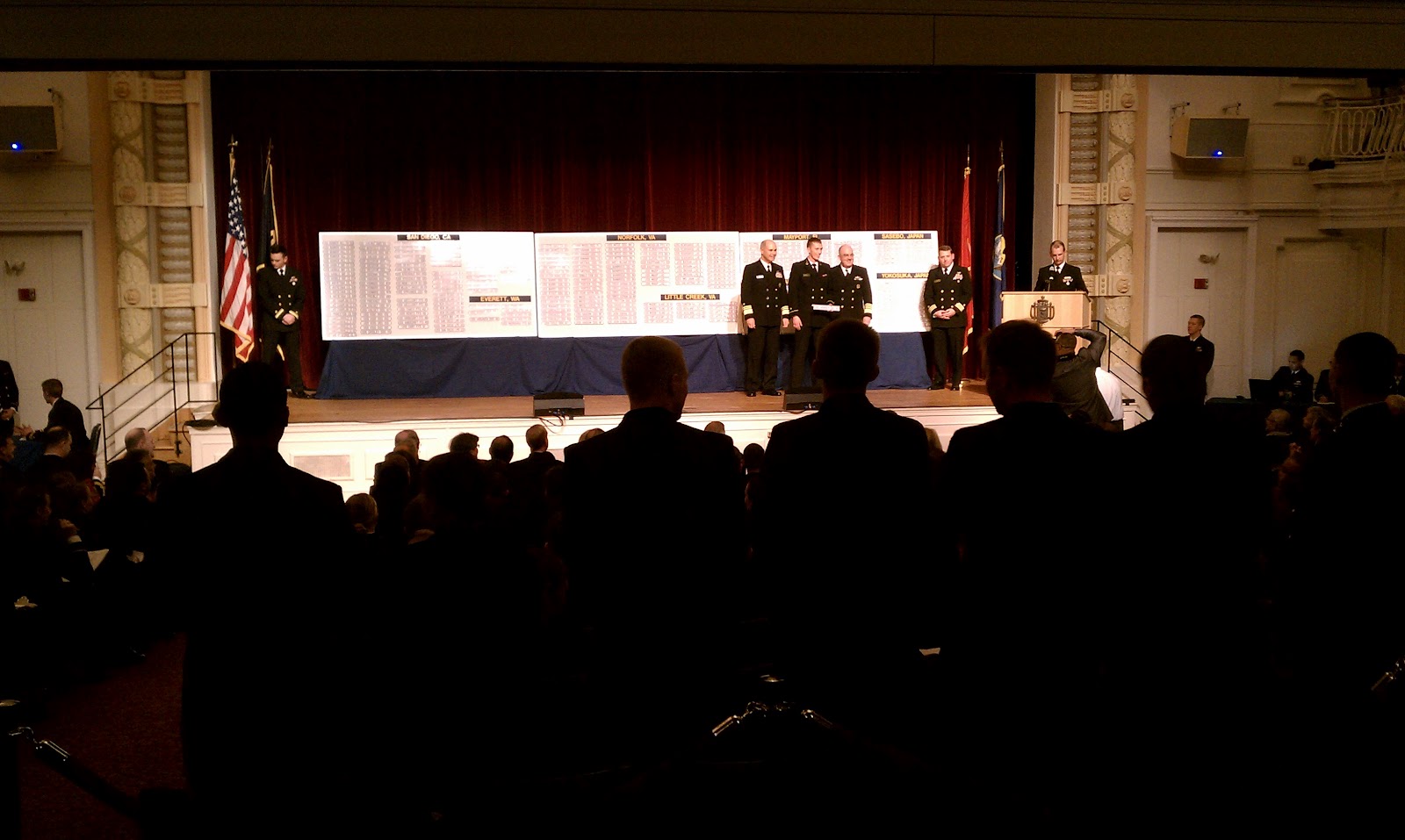
Last night, I attended Ship Selection night for the First Class Midshipmen at the Naval Academy who had earlier selected surface warfare for their service selection. It was a real privilege to participate in the event, 39 years after I made my own service selection. I was joined by VADM Hunt and VADM Miller and we were all extremely impressed (and inspired!) by the motivation and excitement of these young men and women as they made the very important decision on where to begin their shipboard careers.
On the board were warships in every homeport and of every ship class. Where possible, representatives from some ships were present for the selection. Each selecting Midshipman walked to the board when called up according to his or her order of merit in the Class of 2012, picked their choice of ship from the board and proudly displayed their selection to the audience (who often responded with loud cheers!). Whether the decision was based on ship class, homeport, prior experience on a midshipman cruise, or to simply share the experience with classmates on the same ship, each Midshipman made the choice that was right for him or her.
The first selection off the board was USS MOMSEN (DDG 92) homeported in Everett, Washington and homeports of San Diego and Japan were definitely popular. But I know that each of these future officers will thrive and excel aboard their selected ship. In all, over 280 members of the Class of 2012 selected their ships yesterday. At the end of November, the other members of the class had received their service selections. 344 chose Naval Aviation, 272 selected USMC, 140 opted for Submarines, and 44 were selected for Special Warfare or Special Operations, with the remaining Midshipmen selecting medical school, intelligence, civil engineering, or information warfare communities.
When it was my turn to speak to the group of future Surface Warfare Officers, I talked to them about Commodore Stephen Decatur and the comments he made to his wardroom officers aboard the Frigate USS UNITED STATES as they headed off to war with Great Britain in the War of 1812. Commodore Decatur is prominently featured at the Academy, and his capture of the Royal Navy Frigate, HMS MACEDONIAN, is commemorated by the Macedonian Monument at the end of USNA's Stribling Walk. That monument is one of many reminders around the yard about the history of the War of 1812, but over time we lose awareness of the humanity that formed the basis for those monuments. People become paintings and plaques, but they were not so. They laid their lives on the line. When Decatur spoke to his crew, he did not speak to them of seamanship or tactics. What he desired from them was courage, both physical and moral. I reminded the Midshipmen that the same sort of challenge is ahead of them. As they sail their ships into harm's way, much will be asked of them. There is no place we sail today that is a benign environment. We need them to be ready from day one of their tour.
When I spoke with these young men and women last night I saw the same determination Decatur sought in his wardroom of officers so many years ago. It was a strong reminder to me that our traditions are strong and we have the finest Sailors in the world. And I know that the future Surface Warriors I visited with on this important day in their career will BE READY!
Congratulations Class of 2012 – I was honored to share your evening with you and I am very proud to serve with you!
All the best, JCHjr
Click here to watch the full video of the event, including my brief remarks to the Midshipmen.


Last night, I attended Ship Selection night for the First Class Midshipmen at the Naval Academy who had earlier selected surface warfare for their service selection. It was a real privilege to participate in the event, 39 years after I made my own service selection. I was joined by VADM Hunt and VADM Miller and we were all extremely impressed (and inspired!) by the motivation and excitement of these young men and women as they made the very important decision on where to begin their shipboard careers.
On the board were warships in every homeport and of every ship class. Where possible, representatives from some ships were present for the selection. Each selecting Midshipman walked to the board when called up according to his or her order of merit in the Class of 2012, picked their choice of ship from the board and proudly displayed their selection to the audience (who often responded with loud cheers!). Whether the decision was based on ship class, homeport, prior experience on a midshipman cruise, or to simply share the experience with classmates on the same ship, each Midshipman made the choice that was right for him or her.
The first selection off the board was USS MOMSEN (DDG 92) homeported in Everett, Washington and homeports of San Diego and Japan were definitely popular. But I know that each of these future officers will thrive and excel aboard their selected ship. In all, over 280 members of the Class of 2012 selected their ships yesterday. At the end of November, the other members of the class had received their service selections. 344 chose Naval Aviation, 272 selected USMC, 140 opted for Submarines, and 44 were selected for Special Warfare or Special Operations, with the remaining Midshipmen selecting medical school, intelligence, civil engineering, or information warfare communities.
When it was my turn to speak to the group of future Surface Warfare Officers, I talked to them about Commodore Stephen Decatur and the comments he made to his wardroom officers aboard the Frigate USS UNITED STATES as they headed off to war with Great Britain in the War of 1812. Commodore Decatur is prominently featured at the Academy, and his capture of the Royal Navy Frigate, HMS MACEDONIAN, is commemorated by the Macedonian Monument at the end of USNA's Stribling Walk. That monument is one of many reminders around the yard about the history of the War of 1812, but over time we lose awareness of the humanity that formed the basis for those monuments. People become paintings and plaques, but they were not so. They laid their lives on the line. When Decatur spoke to his crew, he did not speak to them of seamanship or tactics. What he desired from them was courage, both physical and moral. I reminded the Midshipmen that the same sort of challenge is ahead of them. As they sail their ships into harm's way, much will be asked of them. There is no place we sail today that is a benign environment. We need them to be ready from day one of their tour.
When I spoke with these young men and women last night I saw the same determination Decatur sought in his wardroom of officers so many years ago. It was a strong reminder to me that our traditions are strong and we have the finest Sailors in the world. And I know that the future Surface Warriors I visited with on this important day in their career will BE READY!
Congratulations Class of 2012 – I was honored to share your evening with you and I am very proud to serve with you!
All the best, JCHjr
Click here to watch the full video of the event, including my brief remarks to the Midshipmen.



18 January 2012
Surface Navy Association (SNA) Symposium (2012)
Team,
Last week, I had the privilege of speaking at the Surface Navy Association (SNA) National Symposium. This presentation was particularly important for me because I covered many topics (and issues) that I believe are central to our Navy now and in the future. Although the symposium is held for the Surface force, my remarks, and the lessons I discuss, are broad enough that I believe they apply to everyone – regardless of your community.
I encourage you to watch the video of my presentation or read the remarks and let me know what you think; your feedback is always welcomed and appreciated.
I also recommend you read my remarks from the 2010 symposium and watch the video of my remarks from last year‘s (2011) symposium as both messages are still very relevant today. All the best, JCHjr
Last week, I had the privilege of speaking at the Surface Navy Association (SNA) National Symposium. This presentation was particularly important for me because I covered many topics (and issues) that I believe are central to our Navy now and in the future. Although the symposium is held for the Surface force, my remarks, and the lessons I discuss, are broad enough that I believe they apply to everyone – regardless of your community.
I encourage you to watch the video of my presentation or read the remarks and let me know what you think; your feedback is always welcomed and appreciated.
I also recommend you read my remarks from the 2010 symposium and watch the video of my remarks from last year‘s (2011) symposium as both messages are still very relevant today. All the best, JCHjr
06 December 2011
“Trial by Fire”
Team,
Attached (here) is an essay written by VADM Jim Stockdale USN (ret) from his book “Thoughts of a Philosophical Fighter Pilot” in which he shares the five qualities he believes are essential in leaders during turbulent and difficult times. Now, I understand there are a lot of leadership books out there, but VADM Stockdale’s views are particularly compelling because they were shaped by the seven years of “death and hopelessness” he endured as a prisoner of war in Vietnam. His story is one of great struggle and determination to lead and guide his fellow prisoners (he was the senior officer) under the most challenging conditions imaginable and stand by his convictions (he would rather die than submit) during the most perilous of times (read his bio here).
I want to share this essay with you because I believe (as I’ve said here many times) that the times are indeed changing and VADM Stockdale’s message concerning the essentials of leadership is just as relevant and important today as when he wrote it for us in 1985.
All the best, JCHjr
Attached (here) is an essay written by VADM Jim Stockdale USN (ret) from his book “Thoughts of a Philosophical Fighter Pilot” in which he shares the five qualities he believes are essential in leaders during turbulent and difficult times. Now, I understand there are a lot of leadership books out there, but VADM Stockdale’s views are particularly compelling because they were shaped by the seven years of “death and hopelessness” he endured as a prisoner of war in Vietnam. His story is one of great struggle and determination to lead and guide his fellow prisoners (he was the senior officer) under the most challenging conditions imaginable and stand by his convictions (he would rather die than submit) during the most perilous of times (read his bio here).
I want to share this essay with you because I believe (as I’ve said here many times) that the times are indeed changing and VADM Stockdale’s message concerning the essentials of leadership is just as relevant and important today as when he wrote it for us in 1985.
All the best, JCHjr
30 November 2011
Holiday Reading Ideas
Team, I hope all of you get a chance to regroup and recharge over the coming holidays because it looks like we've got a pretty sporty year ahead of us on just about every front you can imagine.
But it's certainly nothing we can't handle; after all, we've been there before in our Navy's history and have always managed to come through because of the enduring strength of our people and our understanding of the fundamentals of our profession.
So, as you prepare for the challenges ahead, I thought I'd offer up some possibilities for your holiday reading - the time when you get to "sharpen the saw" - from some of the books I've read in the past year and found to be particularly worthwhile; these books were inspiring, thought-provoking and very well-written. Here they are:
Pacific Crucible - Ian Toll
Neptune's Inferno - James D. Hornfischer
On China - Henry Kissinger
Monsoon - Robert Kaplan
Agents of Innovation - Thomas Kuehn
Good Strategy/Bad Strategy - Richard Rumelt
I'll group the first two together: Pacific Crucible by Ian Toll (author of Six Frigates) and Neptune's Inferno by James Hornfischer (author of Last Stand of the Tin Can Sailors).
Pacific Crucible sets the stage for the early war in the Pacific - how the Japanese developed the strategy that led to the very successful early attacks on Pearl Harbor and the Philippines in early December, 1941 and how that strategy led inexorably to the Battle of Midway. The fascinating part of the story for me was how our Navy learned from and responded to these early disasters and was in a position to strike the devastating blows at Midway in early June 1942.
James Hornfischer then picks up the story of the early war in the Pacific with a riveting account of the Solomon Islands campaign, our nation's first offensive campaign in WWII that began with the invasion of Guadalcanal by the Marines (the First Marine Division) and ended after seven very costly naval battles in and around Ironbottom Sound - the Marines hung on ashore and kept Henderson Field open and the Navy hung on at sea. By the end of November, 1942 the outcome could be seen - Guadalcanal would be held and the critical sea lines of communication to Australia would be maintained.
Again, it was a story of learning under fire and against great odds - not only would our Navy have to go to back to school on the tactics, techniques and procedures that would defeat the Japanese, but our Navy would have to learn what it meant to fight in a total war at sea and everyone, from our Admirals to our COs to our Sailors on the deckplates, had a great deal to learn.
Here are the publisher's notes for these two excellent books:
Neptune's Inferno - With The Last Stand of the Tin Can Sailors and Ship of Ghosts, James D. Hornfischer created essential and enduring narratives about America's World War II Navy, works of unique immediacy distinguished by rich portraits of ordinary men in extremis and exclusive new information. Now he does the same for the deadliest, most pivotal naval campaign of the Pacific war: Guadalcanal.
Neptune's Inferno is at once the most epic and the most intimate account ever written of the contest for control of the seaways of the Solomon Islands, America's first concerted offensive against the Imperial Japanese juggernaut and the true turning point of the Pacific conflict. This grim, protracted campaign has long been heralded as a Marine victory. Now, with his powerful portrait of the Navy's sacrifice-three sailors died at sea for every man lost ashore-Hornfischer tells for the first time the full story of the men who fought in destroyers, cruisers, and battleships in the narrow, deadly waters of "Ironbottom Sound." Here, in brilliant cinematic detail, are the seven major naval actions that began in August of 1942, a time when the war seemed unwinnable and America fought on a shoestring, with the outcome always in doubt. But at Guadalcanal the U.S. proved it had the implacable will to match the Imperial war machine blow for violent blow.
Working from new interviews with survivors, unpublished eyewitness accounts, and newly available documents, Hornfischer paints a vivid picture of the officers and enlisted men who took on the Japanese in America's hour of need: Vice Admiral William "Bull" Halsey, who took command of the faltering South Pacific Area from his aloof, overwhelmed predecessor and became a national hero; the brilliant Rear Admiral Norman Scott, who died even as he showed his command how to fight and win; Rear Admiral Daniel Callaghan, the folksy and genteel "Uncle Dan," lost in the strobe-lit chaos of his burning flagship; Rear Admiral Willis Lee, who took vengeance two nights later in a legendary showdown with the Japanese battleship Kirishima; the five Sullivan brothers, all killed in the shocking destruction of the Juneau; and many others, all vividly brought to life.
The first major work on this essential subject in almost two decades, Neptune's Inferno does what all great battle narratives do: It cuts through the smoke and fog to tell the gripping human stories behind the momentous events and critical decisions that altered the course of history and shaped so many lives. This is a thrilling achievement from a master historian at the very top of his game
Pacific Crucible - The planning, the strategy, the sacrifices and heroics-on both sides-illuminating the greatest naval war in history.
On the first Sunday in December 1941, an armada of Japanese warplanes appeared suddenly over Pearl Harbor, Hawaii, and devastated the U.S. Pacific Fleet. Six months later, in a sea fight north of the tiny atoll of Midway, four Japanese aircraft carriers were sent into the abyss. Pacific Crucible tells the epic tale of these first searing months of the Pacific war, when the U.S. Navy shook off the worst defeat in American military history and seized the strategic initiative.
Ian W. Toll's dramatic narrative encompasses both the high command and the "sailor's-eye" view from the lower deck. Relying predominantly on eyewitness accounts and primary sources, Pacific Crucible also spotlights recent scholarship that has revised our understanding of the conflict, including the Japanese decision to provoke a war that few in the country's highest circles thought they could win. The result is a page-turning history that does justice to the breadth and depth of a tremendous subject. 24 pages of black-and-white illustrations and 12 maps
On China
One of the great national security challenges for our nation, today and for the foreseeable future, is the nature of our relationship with China. Our shipmates in the Pacific Fleet live with this challenge every day as China's economic power and global influence continues to grow steadily. Along with China's economic clout, her military, and particularly her navy, is also growing steadily in both capacity and capability. But to what end?
No more important question exists for us and getting to an answer to that question is something all of us ought to be thinking about.
To help you think about the future of our relationship with China, I strongly recommend On China, by Henry Kissinger, the former National Security Affairs advisor to President Nixon and the former Secretary of State for both Presidents Nixon and Ford. As the National Security Affairs advisor, Dr Kissinger engineered the famous opening to China that culminated in President Nixon's historic trip 1972 trip to Beijing.
His book covers a great deal of history and does much to illuminate how China sees itself, a vision that drives how China sees its place in the world. The rise and emergence of China is a fascinating story that Dr Kissinger tells very well.
Here are the publisher's notes for On China:
In this sweeping and insightful history, Henry Kissinger turns for the first time at book-length to a country he has known intimately for decades, and whose modern relations with the West he helped shape. Drawing on historical records as well as his conversations with Chinese leaders over the past forty years, Kissinger examines how China has approached diplomacy, strategy, and negotiation throughout its history, and reflects on the consequences for the global balance of power in the 21st century.
Since no other country can claim a more powerful link to its ancient past and classical principles, any attempt to understand China's future world role must begin with an appreciation of its long history. For centuries, China rarely encountered other societies of comparable size and sophistication; it was the "Middle Kingdom," treating the peoples on its periphery as vassal states. At the same time, Chinese statesmen-facing threats of invasion from without, and the contests of competing factions within-developed a canon of strategic thought that prized the virtues of subtlety, patience, and indirection over feats of martial prowess.
In On China, Kissinger examines key episodes in Chinese foreign policy from the classical era to the present day, with a particular emphasis on the decades since the rise of Mao Zedong. He illuminates the inner workings of Chinese diplomacy during such pivotal events as the initial encounters between China and modern European powers, the formation and breakdown of the Sino-Soviet alliance, the Korean War, Richard Nixon's historic trip to Beijing, and three crises in the Taiwan Straits. Drawing on his extensive personal experience with four generation of Chinese leaders, he brings to life towering figures such as Mao, Zhou Enlai, and Deng Xiaoping, revealing how their different visions have shaped China's modern destiny.
With his singular vantage on U.S.-China relations, Kissinger traces the evolution of this fraught but crucial relationship over the past 60 years, following its dramatic course from estrangement to strategic partnership to economic interdependence, and toward an uncertain future. With a final chapter on the emerging superpower's 21st-century world role, On China provides an intimate historical perspective on Chinese foreign affairs from one of the premier statesmen of the 20th century.
Monsoon
Robert Kaplan has given us another terrific book that opens up the history and explains the importance of the Indian Ocean and the nation states that ring its littoral regions to the future security and economic well-being of the United States. For those of us who have spent a great deal of time plying the waters of the "IO", the NAG, the Arabian Gulf and the Red Sea, this book provides a very fresh look at a region that perhaps many of us thought we already knew pretty well.
Starting with Balkan Ghosts and on through to Hog Pilots, Blue Water Grunts: The American Military in the Air, at Sea and on the Ground, Kaplan has given us a series of books that focused on the global zones of conflicts from 1999-2010 and how our nation and our military forces have responded to the wide variety of challenges that have come out way during that time. He is an acute observer of the world and of us; we can learn much from him.
Here are the publisher's notes for Monsoon:
On the world maps common in America, the Western Hemisphere lies front and center, while the Indian Ocean region all but disappears. This convention reveals the geopolitical focus of the now-departed twentieth century, but in the twenty-first century that focus will fundamentally change. In this pivotal examination of the countries known as "Monsoon Asia"-which include India, Pakistan, China, Indonesia, Burma, Oman, Sri Lanka, Bangladesh, and Tanzania-bestselling author Robert D. Kaplan shows how crucial this dynamic area has become to American power. It is here that the fight for democracy, energy independence, and religious freedom will be lost or won, and it is here that American foreign policy must concentrate if the United States is to remain relevant in an ever-changing world. From the Horn of Africa to the Indonesian archipelago and beyond, Kaplan exposes the effects of population growth, climate change, and extremist politics on this unstable region, demonstrating why Americans can no longer afford to ignore this important area of the world.
Agents of Innovation
One of the things that has long fascinated me about our Navy's history is how, after World War I and throughout the Great Depression (1929-1940), at a time when our budgets were low and cut repeatedly, our ships were routinely manned at 50-75% and the nation has approximately zero interest in anything to do with its military, the Navy, along with the Marine Corps, managed the most productive period of strategic thought as well as tactical and operational innovation in its history. Think about it - the forces and operational foundations for the greatest trans-oceanic campaign in history, the war against Japan 1941-1945, were developed and evolved from 1920-1940. The Fleet logistics train and the concept of forward deployed maintenance, coordinated aircraft carrier operations, underway replenishment, the fundamentals of amphibious warfare - 2 classes of battleships, 5 classes of heavy and light cruisers, 4 classes of destroyers, the fleet submarine and the fighters, torpedo bombers and patrol planes that fought at Coral Sea and Midway - all came during the Depression. How did they do it?!
Agents of Innovation tells the story of how it was done and who did it. While the story alone is well worth the read, the lessons from this book that we can learn and apply to the situation we're in today are of staggering importance to us. Mark Twain said that history may never exactly repeat itself, but it sure can rhyme - I think we are in a period where what we face in terms of declining budgets and growing strategic challenges rhymes pretty well with what our predecessors faced in the 20s and 30s. We have much to learn from them.
Here are the publisher's notes on Agents of Innovation:
The author examines the influence of the General Board of the U.S. Navy as an agent of innovation in the years between the world wars. A formal body established by the secretary of the Navy, the General Board served as the organizational nexus for the interaction between fleet design and the naval limitations imposed on the Navy by treaty. Particularly important, Kuehn argues, was the Board's role in implementing the Washington Naval Treaty, which limited naval armaments after 1922. Kuehn explains that the leadership of the Navy at large and the General Board in particular felt themselves especially constrained by Article XIX of the Washington Naval Treaty, which implemented a status quo on naval fortifications in the western Pacific.
Good Strategy/Bad Strategy
This book is really a guide to thinking critically about strategy and can be applied to everyone in uniform who is responsible for some level of mission accomplishment wherever they may be stationed.
A good strategy is a specific and coherent response to - and approach for overcoming - the obstacles to progress on a given task or mission set of any magnitude.
Early in 1941, American military leaders began secret discussions with their British counterparts to hammer out the fundamentals of the strategy to defeat the Axis powers when America entered the war alongside the British. Despite not knowing when or how America's entry would take place, both Roosevelt and Churchill knew it was both inevitable and required for the ultimate defeat of Nazi Germany. The essence of the ultimate strategy was simple, yet profound - Germany First. That concept drove everything the Allies did from 1941-1945 despite the deep national anger and desire for revenge in the US that resulted from the Japanese attack on Pearl Harbor. President Roosevelt kept his gaze steady and his focus clear - Germany First.
President Roosevelt understood the true nature of the situation - Japan could not defeat the US, but Germany and to defeat Germany, Roosevelt needed to keep the Russians in the fight on the side of the allies. Thus, Germany First properly focused the allies and harnessed and applied the full weight of military power where it would have the most important effect - the essence of sound strategy. This strategy drove choices and enabled critical priorities to be determined. Deciding what not to do was as important as figuring out what had to be done.
Rumelt brings it all together for you; it's a great book.
Here are the publisher's notes on Good Strategy/Bad Strategy:
This is the long-awaited magnum opus from 'strategy's strategist'. Even though everyone is talking about it, there is no concept in business today more muddled than 'strategy'. Richard Rumelt, described by "McKinsey Quarterly" as 'a giant in the field of strategy' and 'strategy's strategist', tackles this problem head-on in a jargon-free explanation of how to develop and take action on strategy, in business, politics and beyond. Rumelt dispels popular misconceptions about strategy - such as confusing it with ambitions, visions or financial goals - by very practically showing that a good strategy focuses on the challenges a business faces, and providing an insightful new approach for overcoming them. His sharp analysis and his brilliant, bold style make his book stand out from its competitors (something that Rumelt himself says is crucial). Rumelt has always challenged dominant thinking, ever since, in 1972, he was the first person to uncover a statistical link between corporate strategy and profitability - and this is his long-awaited tour de force.
16 November 2011
USMC Birthday Ball Remarks
Note: Team, my ERB post from Monday generated a lot of interest and comments due to the importance of the topic. Although I am keeping to my regular drumbeat of posts (beginning with this one), I will definitely keep the ERB thread open to continue our discussion; I’ll check your comments regularly and do my best to respond to your questions and concerns.
All the best, JCHjr
Team,
Last week I had the great privilege of being the guest of honor at the II MEF Marine Corps Birthday Ball in Camp Lejeune, North Carolina (my remarks are here). This event was indeed truly memorable for me and I was greatly honored to participate. I was able to spend a terrific evening with the Marines at the very heart of the Marine Corps, Camp Lejeune.
I took advantage of my time in Camp Lajeune to meet with the 2D Marine Logistic Group (MLG) to receive a brief from the Bold Alligator logistics team and do some prep work for the upcoming exercise. I was particularly interested in this brief because logistics will be squarely at the center of nearly everything we do during Bold Alligator 2012.
The public debate on large-scale amphibious operations today tends to be focused on the relevance of the opposed landing ashore, but BA12 will be much more about demonstrating our uniquely Naval, rpt Naval, ability to establish a sea base and conduct and sustain a wide range of expeditionary operations from the sea. While we have this expeditionary sea-basing capability today (as the Navy-Marine Corps Team amply demonstrated during the Haiti earthquake relief operation in 2010), this exercise will be broader in nature and serve as an opportunity to test our ability to plan and execute these extensive operations with the forces we have today.
With all the anxiety over the inevitable cuts to our budget, there is no shortage of so-called “experts” predicting with great certainty the future of armed conflict for the next 20 years. In my experience, these predictions are generally 100% wrong almost 100% of the time and it is for this reason that we must stay focused on the missions that we must be able to execute today with the forces that we have today. This is what BA12 is all about.
Thanks again to LtGen Jay Paxton and the II MEF Marines for allowing me to participate in their Birthday Ball – it was indeed an honor for me to spend the evening with them and celebrate the 236th birthday of the United States Marine Corps.
All the best, Happy Birthday Marines and Semper Fidelis, JCHjr
All the best, JCHjr
Team,
Last week I had the great privilege of being the guest of honor at the II MEF Marine Corps Birthday Ball in Camp Lejeune, North Carolina (my remarks are here). This event was indeed truly memorable for me and I was greatly honored to participate. I was able to spend a terrific evening with the Marines at the very heart of the Marine Corps, Camp Lejeune.
I took advantage of my time in Camp Lajeune to meet with the 2D Marine Logistic Group (MLG) to receive a brief from the Bold Alligator logistics team and do some prep work for the upcoming exercise. I was particularly interested in this brief because logistics will be squarely at the center of nearly everything we do during Bold Alligator 2012.
The public debate on large-scale amphibious operations today tends to be focused on the relevance of the opposed landing ashore, but BA12 will be much more about demonstrating our uniquely Naval, rpt Naval, ability to establish a sea base and conduct and sustain a wide range of expeditionary operations from the sea. While we have this expeditionary sea-basing capability today (as the Navy-Marine Corps Team amply demonstrated during the Haiti earthquake relief operation in 2010), this exercise will be broader in nature and serve as an opportunity to test our ability to plan and execute these extensive operations with the forces we have today.
With all the anxiety over the inevitable cuts to our budget, there is no shortage of so-called “experts” predicting with great certainty the future of armed conflict for the next 20 years. In my experience, these predictions are generally 100% wrong almost 100% of the time and it is for this reason that we must stay focused on the missions that we must be able to execute today with the forces that we have today. This is what BA12 is all about.
Thanks again to LtGen Jay Paxton and the II MEF Marines for allowing me to participate in their Birthday Ball – it was indeed an honor for me to spend the evening with them and celebrate the 236th birthday of the United States Marine Corps.
All the best, Happy Birthday Marines and Semper Fidelis, JCHjr
26 October 2011
Our Sailors
Team,
During my time in command of Fleet Forces, I’ve spent a lot of time visiting our Fleet units and talking here about the unique capabilities I’ve observed our Sailors bringing to the fight every day.
During Operation Unified Response, we saw firsthand what it truly means to be a ready force – from our initial response and through weekly updates to my personal observations while I was on station discussing all the great things our Sailors were doing to assist the Haitian people.
We got a good look at the USS TEMPEST, RIVGRU 1 and NECC, the extremely capable crew of USNS SACAGAWEA and observed our Seabees building an Elevated Causeway System; a capability that is unmatched by any Navy in the world.
I’ve checked in from CENTCOM while spending Thanksgiving with our Sailors in 2009 and 2010 (more photos here), paid a visit to our Sailors at JTF GTMO, and had the great privilege of spending time with a truly inspirational group of men and women at Brooke Medical Center in San Antonio, Texas.
We learned about the importance of flexibility with the HSC-22 Sea Knights, the rapid deployment capabilities of the Airborne Mine Countermeasures squadron HM-14, and got an up close and personal look at the E-2D, E-6B (TACAMO), and F/A-18 in action.
I released (and shared with you) a series of “Practices of Successful Commands (I, II, III, IV)” messages to emphasize the importance of programs that I believe have the greatest influence on our Sailors, their families, and our Navy.
We saw the “Mighty Memphis” off on her final patrol, welcomed USS PONCE home from hers and paid a visit to the very talented Sailors of USS THEODORE ROOSEVELT to observe all the hard work carried out during her RCOH to get her ready for the next 25 years of her operational life.
We talked about the battles of Leyte Gulf, Savo Island, USS CONSTITUTION vs. HMS GUERRIERE, and followed the truly remarkable voyage of the USS OREGON (BB 3).
When Secretary of Defense Gates announced the disestablishment of SECOND Fleet, our staffs put together the right plan and worked hard to bring the two organizations (USFF and C2F) together on schedule and with no impact to Fleet operations.
As the CNO’s Executive Agent for Individual Augmentees, I’ve consistently used your feedback, here and on the USFF Staff Page, to work to improve the service, processes and support we deliver to our IAs and their families.
As the CNO’s Executive Agent for Anti-Terrorism and Force Protection (ATFP), I released my SERIAL guidance to assess the effectiveness of our program and make the changes needed to make ATFP a permanent part of our culture.
Last October, DRRS-N officially replaced SORTS; we worked to put the program on a path to sustainment and updated you along the way. We discussed the concept of readiness and the importance of being a global Navy, talked about what it takes to keep the Fleet in the fight (then and now), the importance of investing in our ships and our people, and looked at the many initiatives we’re taking to improve maintenance and Surface force readiness.
We had many frank discussions about the importance of changing our culture to prioritize operational readiness (through technical excellence) and ensure that, although there are things we will do less, we must never do less well.
And finally, we honored the legacies of VADM Samuel Gravely, Corporal Jason Dunham, and BMCM Carl Brashear, and said goodbye to our shipmate, Chief Bob Feller.
All these things that we do every day – from the combat operations in Afghanistan to the largest humanitarian assistance and disaster relief effort ever supported by our Navy – would not be possible without our Sailors.
Our Sailors, dedicated professionals who always get the job done.
Our Sailors, held together by the common bonds of sacrifice, service and loyalty.
Our Sailors, the common element behind every success of our Navy.
Our Sailors, the heart and soul of our Navy.
I’ve never been more proud of the men and women I serve with today. Everything we do today always comes back to our Sailors, the true strength of our Navy and the real power of our platforms.
All the best, JCHjr
Subscribe to:
Posts (Atom)
